Home and Belonging
The Edge of the WorldHome and Belonging is a recurring concern in Shay’s story, where an address, a family tree, and a feeling of being held by others do not always point to the same place. His investigation into his biological origins reveals a Polish family history marked by loss and separation, but it does not displace the people who raised him. Instead, the novel lets different forms of kinship coexist: the Maloneys’ everyday care, the grandparents he never knew, Ollie’s home, and the intimate sense of home Shay associates with Ollie himself.
Care and Chosen Kin
Belonging first appears as practical, bodily care. During the tour, Shay injects insulin into his stomach and eats breakfast; when Larry sits beside him, Shay finds comfort in Larry’s reassuring bulk. Though he finds the idea of leaning on anyone disturbing, he dozes with his head on Larry’s shoulder. That small surrender makes visible a trust that Shay might otherwise resist: care can become familiar through presence before he is ready to name it. Corina later returns and takes him away, but Larry’s brief companionship has already given the scene its sense of shelter. Larry’s steadiness also extends beyond physical comfort. When Ollie leaves the bus after falling out with Jumbo, Larry follows to explain that Jumbo is upset about losing contact with his own kin, but still cares deeply about Shay. He adds that the band accepts Shay’s bisexuality. In this exchange, the group’s belonging is not presented as perfect agreement: Jumbo is hurt and angry, and Ollie is ready to leave. Yet Larry distinguishes conflict from rejection, assuring Ollie that the band’s affection for Shay remains. Chosen kinship is shown as a practice of staying connected through friction, not as an absence of it. The limits of outsiders’ claims on Shay’s family story emerge when Ollie reveals that his research is about Shay himself, not the adoptive family. Shay is shocked; he understands that the studio wanted him because he was adopted, as though that fact made the history more marketable. Although he has signed the contract, he asks to delay the work until he can speak to his father. His response makes the adoptive relationship more than background information in a genealogy project: Shay treats his father as someone to whom he owes honesty, and insists on a say in how the story of his origins begins.
Rooms That Become Home
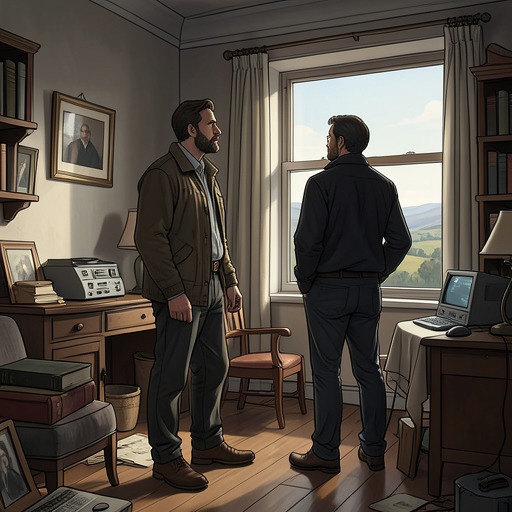
For Ollie, home has long meant refuge through solitude. His small flat is a sanctuary, deliberately kept apart from other people while he lives with the bodily and mental aftermath of the crash. Corina’s advice that he get away from the crowded bus and the constant audience makes him picture Shay in that private space: on the couch, in the kitchen doorway, and asleep in his bed. The images excite him, but they also expose his shame at letting Shay see the place where his injury and isolation have shaped daily life. Home becomes both protection and a risk: to invite someone in is to make private vulnerability visible. Shay experiences welcome differently when Ollie brings him to his grandparents’ ground-floor flat. At the doorway, the paprika scent associated with the Newcastle cafe reaches him, and he feels at home before he has had time to explain why. Ollie’s grandparents, Oliwia and Feodor, receive him into a lived-in family world. Oliwia serves cabbage and sausage broth; the kitchen is colourful and untidy, with sausages hanging from the ceiling, caraway seeds in a sack, and a black cat free to climb onto the counter. Shay notices that the goulash tastes much as it did in Newcastle, allowing the meal to connect this new household with a place he already knows. He likes being there, and after a while he stops missing Ollie. That pause matters: the welcome does not merely ease his separation from Ollie but gives Shay a place he can enjoy in its own right. The relationship between home and absence becomes explicit in Shay’s letter to Ollie. He writes that he misses and loves him, and that nothing feels like home without him. The letter does not reduce home to a building: it describes a sense of belonging altered by Ollie’s absence, while also affirming that Shay remains himself, as he was before they met. His attachment changes the meaning of home without erasing his earlier identity.
The Family History of Separation
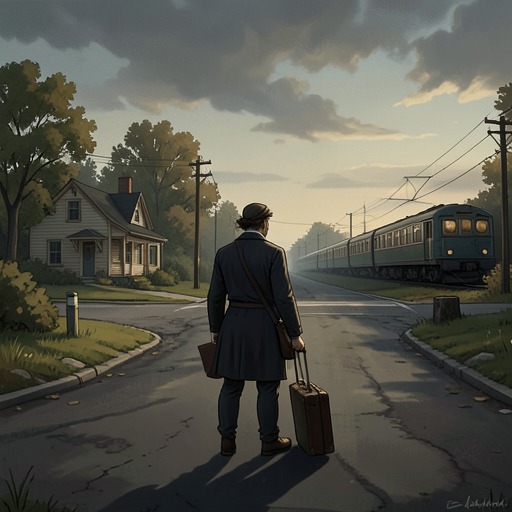
The genealogy investigation supplies a harsher account of home: Shay’s biological grandparents wanted to care for him, but could not keep him. At Francesca King’s grave, Shay asks whether he was present when the fire happened. Ollie says the archived report contains no mention of a baby, although Shay would have been only a few months old. Shay was adopted at two, after six months in foster care, and asks what happened in the intervening period. The records do not resolve every gap, but they lead to a decisive fact: after Francesca died, her parents, Artur and Zofia Nowack, cared for Shay and fought for him. Social services nevertheless removed him and placed him in foster care; Ollie believes the decision may have had something to do with Rudek. As far as he can tell, Shay never saw his grandparents again. The discovery is emotionally complicated because it reveals both loss and wantedness. Shay asks whether Artur and Zofia wanted him, and Ollie tells him that they did, very much. Beneath a willow planted in their honour, Shay clings to Ollie; they move to a nearby bench, sit with their knees touching, and clasp hands. The camera is no longer there, but Shay does not ask about it: he wants Ollie to finish the story. In this moment, the history of separation is met by present-tense care. Ollie’s account cannot return Shay to the grandparents who raised him briefly, but it can tell him that his removal was not proof that they did not want him. Their history gives the word home a specific geography. Artur and Zofia came to London in the 1960s and ran a cafe in Vauxhall. Their two sons left for Leeds in the 1980s; the grandparents continued the cafe together until Zofia became too frail and entered a care home in Pimlico. After the cafe was sold and Zofia died, Artur took her home to Warsaw. Shay learns that his grandparents are buried a mile from Ollie’s family home. The closeness of those graves to a place connected with Ollie makes the family map unexpectedly intimate, but it does not undo the years in which Shay was kept from Artur and Zofia.
Inheritance Without Erasure
By the novel’s closing movement, Shay can acknowledge Polish inheritance without treating it as a replacement identity. He considers using Rudzio as a performer’s name, but rejects Rudzio Nowack: he does not feel entitled to use a name that is not his, and he does not believe he can be entirely one family and none of the other. He remains Shay Maloney, shaped by the people who raised him, while recognizing the biological history he has spent so long learning. For now, he chooses not to seek out surviving members of his biological family. His connection to that history also passes through music. Shay has quickly learned to play the Polish Hurdy-gurdy, now knowing what the instrument is and where it comes from. The choice to consider Rudzio Maloney as a performer’s moniker, rather than Rudzio Nowack, holds cultural inheritance and lived identity together: the past can be carried forward without claiming a name that feels unavailable to him. Meanwhile, Ollie edits the genealogy documentary they filmed on the road. Its final image shows the two men at a distance, heads bowed and hands clasped on a bench. The picture gathers the novel’s different meanings of belonging into one scene: family history may be recovered through research, but the bond visible in the frame is made through presence, touch, and care.